By The Joe Carbone Team
Few communities in the Atlanta metro can claim what Whitewater Creek has built over nearly four decades: a fully gated, manned-entry estate community wrapped around an Arnold Palmer-designed championship golf course, with lakes, wooded acreage, and homes that range from late-1980s Southern manor houses to custom builds from the 2000s and 2010s. The community is fully built out now, which means every home here is a one-of-a-kind product of a specific era, a specific owner's vision, and a specific relationship to the golf course, the lakes, or the tree-lined interior streets.
In this guide, we will walk you through the architectural styles most commonly found in Whitewater Creek, the materials and details that define them, and how these homes have evolved with more modern updates.
Key Takeaways
- Exterior variety is a defining characteristic: Whitewater Creek homes feature a genuine mix of four-sided brick, stucco, brick-and-stucco combinations, and custom masonry
- Estate-scale lots set the context for everything: With most homesites running one to two acres or more, the architecture here is designed to be seen from a distance
- The community spans nearly four decades of construction: Homes built from the late 1980s through the 2010s coexist here
- Golf course, lake, and wooded settings each produce different architectural responses: Homes positioned on the fairways tend to maximize rear views with large windows and expansive terraces
A Community of Estate Homes
The most important thing to understand about Whitewater Creek's architecture is the scale. These are not suburban homes on quarter-acre lots. Most properties here sit on one to two or more acres, with long approach driveways, substantial setbacks from the street, and home sizes that typically range from the mid-3,000s to well over 9,000 square feet.
The architecture was always conceived at an estate scale, and that context shapes everything — from the proportion of the facades to the relationship between the main house and the surrounding land.
The architecture was always conceived at an estate scale, and that context shapes everything — from the proportion of the facades to the relationship between the main house and the surrounding land.
Exterior Materials: Brick, Stucco, and Everything in Between
One of the most common misconceptions about Whitewater Creek is that it is a primarily brick community. In reality, the exterior palette here is genuinely diverse — a product of four decades of custom construction by different builders, architects, and owners with different design philosophies.
Exterior Treatments Found Here
- Four-sided brick estates: Some of Whitewater Creek's most commanding homes are full brick — substantial, permanent-feeling structures that reflect the traditional Southern estate aesthetic
- Stucco and smooth-finish exteriors: A significant portion of the community's homes feature stucco finishes, including many built in the 1990s and 2000s that reflect the European-influenced design that was popular across upscale Atlanta-area communities during that period
- Brick-and-stucco combinations: Many homes blend the two materials (brick at the base and accent elements, stucco across the main body of the facade), creating a layered exterior that references both traditions.
- Stone and custom masonry: Some of the community's newer and more extensively renovated homes incorporate natural stone, board-formed concrete, or other custom masonry treatments.
Grand Entries, Long Driveways, and the Architecture of Arrival
At Whitewater Creek, the experience of arriving at a home is part of its architecture. Most properties are set back significantly from the street, with long driveways that build anticipation before the facade comes fully into view. This approach sequence is one of the community's most consistent architectural qualities, regardless of the home's age or style.
Arrival and Entry Features
- Porte-cochères and motor courts: Several of the community's larger estates feature covered entry drives or circular motor courts that give the arrival experience a formal, deliberate character.
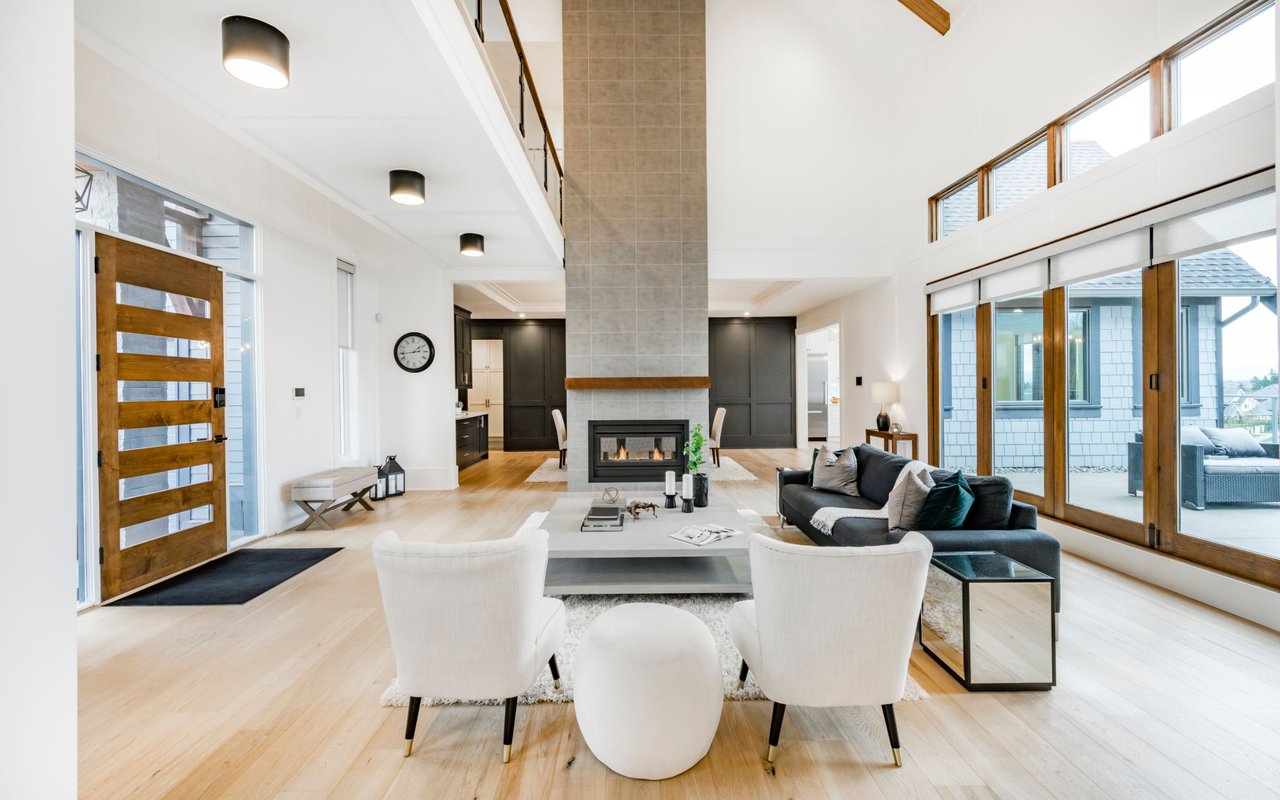
- Grand two-story entry foyers: Interior entries with soaring ceilings, inlaid hardwood floors, and curved or straight staircases are common throughout the community's larger homes.
- Multi-car garages, often courtyard-style: Three- and four-car garages are standard across most of the community's properties, often configured as side-entry or courtyard arrangements that keep the facade uninterrupted.
- Mature landscape framing: Decades of established plantings, large specimen trees, and mature hedging give the approach to most homes a settled, deeply rooted quality that newer communities cannot replicate.
Golf Course and Lakefront Settings Shape the Architecture
Where a home sits within Whitewater Creek significantly influences how it was designed — and how its outdoor living spaces relate to the surrounding landscape. This is not a community where every lot looks the same, and the architecture reflects that variety.
How Setting Influences Design
- Golf course-facing homes: Properties backing onto the Arnold Palmer course typically feature expansive rear terraces, screened or open verandas, and large window groupings oriented toward the fairways.
- Lakefront properties: Homes positioned on the community's lakes tend to organize their living spaces around the water, with rear-facing great rooms, dining areas, and primary suites designed to capture lake views.
- Wooded interior lots: Some of Whitewater Creek's most private homes sit on heavily wooded interior lots where the architecture emphasizes enclosure and seclusion rather than long views.
FAQs
What exterior materials are most common in Whitewater Creek?
The community features a genuine mix — four-sided brick, stucco, brick-and-stucco combinations, and custom masonry are all well represented. Unlike many suburban communities that were built by a single developer to a consistent standard, Whitewater Creek's homes were constructed over nearly four decades by different builders and architects, which is a large part of why no two homes here look alike.
Are Homes in Whitewater Creek Typically Updated or Original?
Many homes have undergone significant interior updates over time, particularly to kitchens, primary suites, and outdoor living areas, while preserving the exterior architectural character that defines each property. The extent of updating varies widely — some homes have been comprehensively renovated, while others retain substantial original character. Both present real value depending on a buyer's priorities.
What makes Whitewater Creek different from other gated communities in the south Atlanta area?
Several things set it apart: the Arnold Palmer-designed golf course at its center, the community's lakes, the estate-scale lot sizes, the manned gate, and the architectural variety that comes from nearly four decades of custom construction. It is also fully built out. As people who live here ourselves, we can say with confidence that the combination of privacy, setting, and architectural character is genuinely difficult to find anywhere else on the south side of Atlanta.
Appreciating the Architecture of Whitewater Creek
The homes in Whitewater Creek are as varied as the people who built them — brick manors from the late 1980s, stucco estates from the 1990s and 2000s, custom builds from the 2010s, and everything in between. What they share is scale, setting, and the kind of presence that comes from being situated on generous acreage within one of Fayette County's most established gated communities.
If you are searching for a home that reflects this architectural character, or if you want guidance on updating a property while preserving its original charm, we are here to help. We live here, we know every street and setting in the community, and we bring that knowledge to every buyer and seller we work with.
Reach out to us at The Joe Carbone Team, and we will help you find or update a home that fits both your style and your needs in Whitewater Creek.
If you are searching for a home that reflects this architectural character, or if you want guidance on updating a property while preserving its original charm, we are here to help. We live here, we know every street and setting in the community, and we bring that knowledge to every buyer and seller we work with.
Reach out to us at The Joe Carbone Team, and we will help you find or update a home that fits both your style and your needs in Whitewater Creek.